 Lars Rossen
87650dac86
Lars Rossen
87650dac86
Adds a slide after the hardware diagram showing the two racks side by side —
the MakerFLOSS rack at Orange Makerspace and the one at home — to make the
point that the module contract is what lets those two rooms run the same
system.

build-slides.sh now copies image files from slides/ into the output tree at
the same relative path. Marp keeps relative image URLs, so without this the
images would 404 on the published site. Guarded against the local build,
where OUTPUT_DIR is the source directory and the copy would be a no-op onto
itself. This is the first deck in the repo with images; the convention is
documented in docs/services/slides.md.

Photos resampled to 1200px on the long edge (~300 KB each) from the 3072x4080
originals.

Co-Authored-By: Claude Opus 5 <noreply@anthropic.com>
32 KiB
| marp | theme | class | paginate | title | description |
|---|---|---|---|---|---|
| true | gaia | invert | true | TAPPaaS one year in — The Good, the Bad, and the Ugly | Sommerhack 2026, Taler Teltet — 27 August, 15:30 |
TAPPaaS — one year in
The Good, the Bad, and the Ugly
Lars Rossen · Sommerhack 2026 · Taler Teltet 27 August, 15:30
Last year, in this tent, I pitched a dream
Everyone needs a cloud in their basement. A Trusted, Automated, fully Private Platform as a Service.
On commodity hardware:
- your data, your hardware
- no hidden fees
- no reliance on closed source
- no reliance on the Internet
A year later I am back with the messy proof that it is real — and to make the case that you should build one too.
The receipts, up front
| First commit | 10 May 2025 — "Initial commit" |
| Commits when I submitted this abstract | 1,091 |
| Commits standing here today | 1,507 |
| Contributors | 3 (I am ~77% of it) |
| ADRs written | 24 |
| Modules — 8 foundation · 12 apps · 21 community | 41 |
| Lines of code (bash · TypeScript · Python · Nix) | 126,699 |
| Of which test code | 34,490 — 27% |
| Lines of documentation | ~39,500 |
Everything in this talk is in two public repositories. You can check my homework.
What I am actually going to do to you
- The Good — it runs. Here is what "it runs" means, and one surprise.
- The Bad — what it really costs, and why that only works if it is shared.
- The Ugly — the confession. I gave an AI root on every node.
- Your turn — why you should build one, and how to start small.
I am not selling anything. There is nothing to buy.
The Good
It runs.
The iron: three boxes, a switch, an AP and a modem
flowchart TB
  n1["<b>tappaas1</b> — ASUS · EPYC 4464P<br/>12c/24t · 64 GB ECC<br/>tanka1 2×4 TB NVMe <b>mirror</b><br/>tankb1 12 TB HDD"]
  n2["<b>tappaas2</b> — Minisforum MS-S1 MAX<br/>Ryzen AI MAX+ 395 · 16c/32t<br/><b>128 GB unified</b> · Radeon 8060S<br/>tanka1 2 TB NVMe"]
  n3["<b>tappaas3</b> — TianBei WTR PRO<br/>Ryzen 7 5825U · 8c/16t · 32 GB<br/>tanka1 1 TB NVMe<br/>tankc1 5 TB HDD — PBS"]
  sw["<b>UniFi USW Pro XG 10 PoE</b><br/>10.0.0.201<br/>trunk: mgmt untagged +<br/>VLAN 200 310 410 420 430 510 610"]
  ap["UniFi Nano HD<br/>access point · port 9"]
  modem["ISP modem<br/>port 5 · VLAN 100 = wan"]
  n1 -- "10G · p12" --> sw
  n2 -- "10G · p2" --> sw
  n3 -- "2.5G · p3" --> sw
  sw --- ap
  sw --- modem
This is one basement. There are 4 other known instances of TAPPaaS.
The same platform, two very different rooms
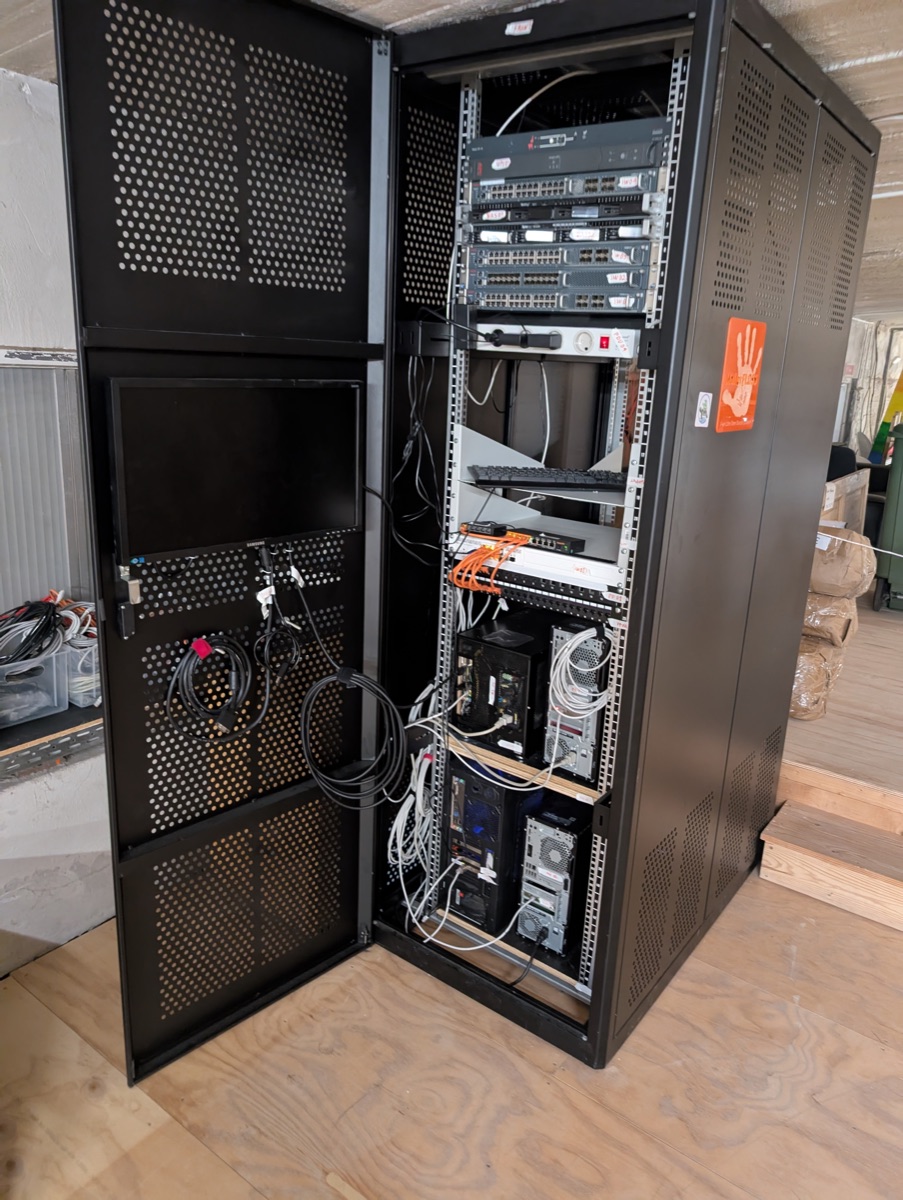
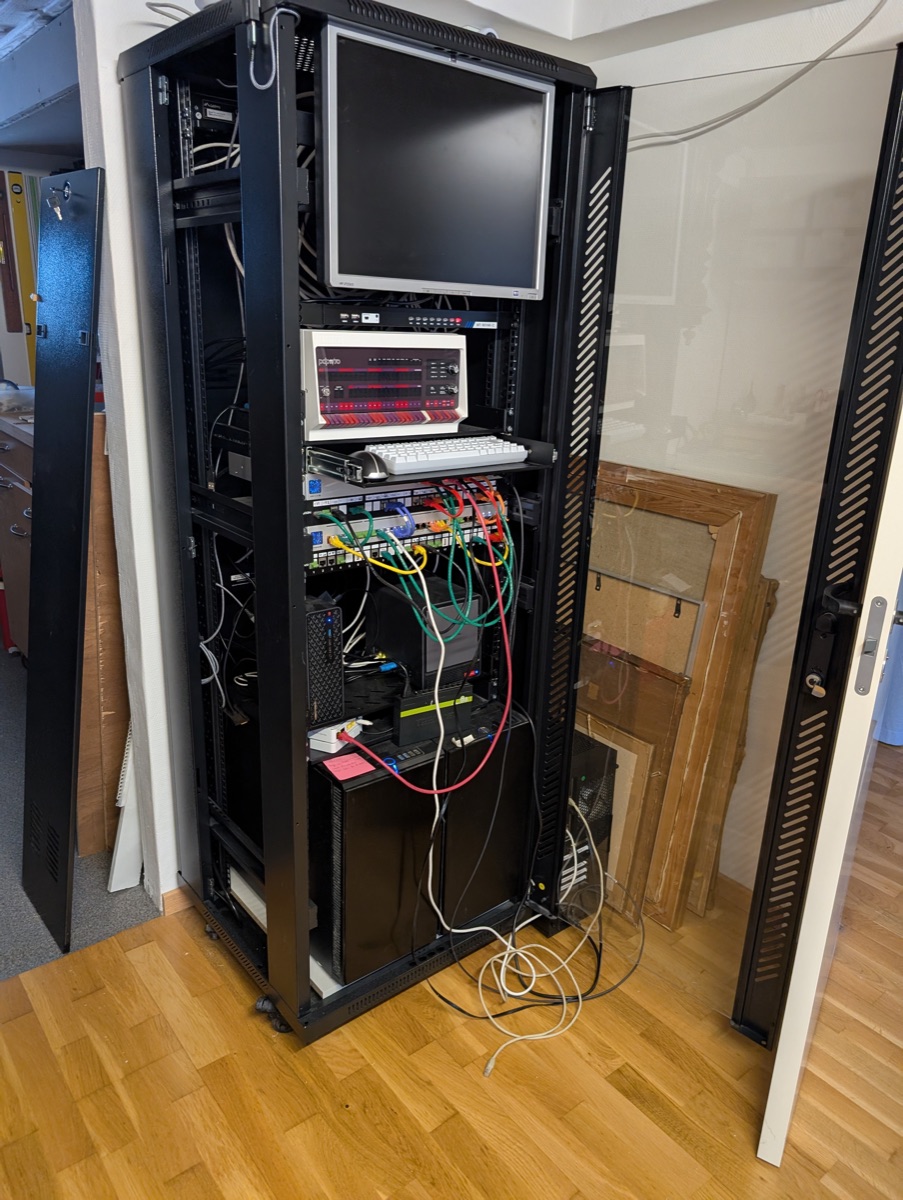
Same modules. Same install.sh. Same tests. Same updates.
The software: foundation underneath, stacks on top
I promised you eight. There are forty-one.
| Where | # | What is in there |
|---|---|---|
| Foundation — TAPPaaS repo | 8 | cluster network templates tappaas-cicd identity backup logging satellite |
| Apps — TAPPaaS repo | 12 | nextcloud euro-office vaultwarden litellm openwebui vllm-amd hass deconz coturn nextcloud-hpb netbird-client windows-server |
| Community repo — other people | 21 | immich jellyfin wordpress forgejo mailserver hosting sonos hue synology reolink solaredge alfen unifi shelly-fleet … |
Twenty-one of those forty-one are not mine. Erik wrote 13, Andreas 6.
That is the number I did not dare put in the abstract.
"It runs" is a bigger claim than it sounds
Every one of those services, without me:
- updates itself on a schedule — and the update is gated by a test
- backs itself up nightly to Proxmox Backup Server, and off-site
- reports its own health, so I find out before my family does
- has a certificate that renews
- has one login — my identity provider, not eight password fields
The interesting engineering is not installing Nextcloud. It is Nextcloud still being there, patched, in eighteen months, unattended.
One idea does all the work: everything is a module
nextcloud/
├── nextcloud.json  # the contract — what it is, needs, provides
├── nextcloud.nix   # the NixOS machine
├── install.sh      # put it there            (once)
├── update.sh       # keep it patched         (on schedule)
├── test.sh         # prove it still works    (gates the update)
└── README.md
The firewall is a module. The backup server is a module. The mothership that installs the modules is a module.
One model to learn, not eight.
dependsOn — the trick the whole thing rests on
{
  "description": "Nextcloud — files, calendar, contacts",
  "vmname": "nextcloud", "vmid": 210,
  "dependsOn": ["cluster:vm", "templates:nixos", "backup:vm",
                "network:proxy", "identity:identity"],
  "config": {
    "cluster:vm": { "cores": 4, "memory": "8192", "diskSize": "64G" },
    "network:proxy": { "proxyPort": 443 }
  }
}
Install order is computed from these declarations. Nobody maintains a list. Add a module, and the platform works out that it needs a VM, an OS, a VLAN, a certificate, a login and a backup job — in that order.
Reduce flexibility. On purpose.
A key design goal is to REDUCE flexibility. There is value in decisions having been taken up front.
Some use cases will not fit TAPPaaS. That is the trade. For what fits, it is dramatically easier.
Zones, VLANs, naming, storage roles, backup policy, identity model — decided. You get to pick the applications, and where they live.
The surprise
My basement grew a brain.
Local AI. Private, offline, mine.
| Silicon | AMD Ryzen AI MAX+ 395 — Radeon 8060S (Strix Halo) |
| Memory | 128 GB unified — the GPU sees nearly all of it |
| Largest model tested | gpt-oss-120b — 120B parameters |
| Speed | ~50 tok/s at 7B FP16 · ~20 tok/s at 30B 4-bit |
| API | OpenAI-compatible, on my own VLAN |
| Data leaving the building | none |
One commodity box. Not a rack, not a hyperscaler, not a monthly bill.
The demo I have been waiting a year to do
Pull the cable out.
Then ask it something.
Why this is the point, not a party trick
Sovereignty is not a checkbox you tick at a vendor.
- The model runs on hardware you own
- Your documents are indexed on your VLAN
- Nobody re-prices it, deprecates it, or reads it
- It works when the fibre is cut, the account is suspended, or the terms of service change on a Tuesday
litellm in front means apps ask for "a model" — local today,
someone else's tomorrow, your choice, revocable.
The Bad
What it actually cost.
The brutal commit graph of a side project
2025-05   99  ██████████  ← the honeymoon
2025-06   21  ██
2025-07   53  █████
2025-08  141  ██████████████  ← Sommerhack 2025
2025-09    6  █  ← vacation
2025-10    9  █
2025-11   41  ████
2025-12   47  █████
2026-01   66  ██████
2026-02  141  ██████████████
2026-03   33  ███
2026-04   19  ██
2026-05  190  ██████████████████
2026-06  351  ██████████████████████████████████  ← something changed
2026-07  164  ████████████████
2026-08  126  ████████████  (to the 25th)
Not a burndown chart. A heartbeat — 1,507 beats, and two months where it nearly flatlined.
The services stayed up through the flat bits anyway, because updates, backups and tests do not need me to be enthusiastic.
June 2026: 351 commits. Something changed.
That is not me getting three times better at typing.
That is the month I leaned all the way into AI-assisted development — which is exactly the confession in part three.
Hold that thought.
The iceberg under every "simple" service
| Files | Lines | |
|---|---|---|
| Foundation — the platform | 575 | 114,138 |
| Apps — the things you actually use | 144 | 15,726 |
For every line in an app module, there are seven lines of platform underneath.
tappaas-cicd alone — the mothership — is 81,942 lines, 72% of the
foundation. Inside it: 8 TypeScript managers (36,920 lines) and the
controller layer that talks to Proxmox, OPNsense and the switch (29,352).
It is a lot of work. That is the argument for sharing it.
Building this was not cheap, and I will not pretend otherwise: 112,000 lines, 1,507 commits, 24 ADRs, six unfamiliar stacks, a year of evenings.
But look at where that cost sits:
| Paid once, by whoever writes it | Paid by you, per site |
|---|---|
| the 8 foundation modules | a box and an afternoon |
| 195 test suites that gate every update | module-manager module add <app> |
| every install, update and repair script | nothing — patches arrive tested |
A hyperscaler amortises a datacentre across a million tenants. We amortise a platform across a thousand basements.
Erik's 13 modules and Andreas's 6 cost me nothing and made my system better. Yours would too. That is the economic case: not that self-hosting is cheap, but that the expensive part only has to happen once.
Did I get it all right?
No. There have been at least two large rewrites — and a whole system before this one.
- The predecessor. Before TAPPaaS existed I ran a hand-built setup for five years, uninterrupted. It never had a name. Every design decision here is an argument I already lost once, at home.
- Rewrite 1 — ADR-003. Every module was a plain
install.shyou ran in the right order, by hand. Replaced bydependsOn/providescontracts, resolved into an install order by the platform. - Rewrite 2 — ADR-007. The flat pile of sequenced scripts became a manager / controller paradigm: 7 TypeScript managers that own intent, 6 controllers that do the live I/O against OPNsense, Authentik, Proxmox, the switch.
Both times the same mistake: I had written as a sequence of steps what needed to be a structure — dependencies the first time, roles the second.
The Ugly
The confession.
I used AI to build it.
And I gave it root on every node.
Not "AI-assisted autocomplete".
Root. ssh. nixos-rebuild. qm. pvesh. The firewall. The secrets.
Why on earth would you do that
Because the alternative was that it never got built.
- One retiree, evenings and weekends, six unfamiliar technology stacks
- 112,000 lines of platform code for thirteen app modules
- The plumbing is tedious, not clever — the exact shape of work to hand over
The graph does not lie: May 190, June 351. That is what handing over the tedium looks like.
And the honest part: I could not have hand-written the last third of this.
So the real question is not "did you"
It is: what did you fence it with?
The guardrails are not vibes. They are written down, in the repo, loaded on every single session, and they override anything the model would otherwise default to.
Guardrail 1 — nothing starts with a prompt
By the time the AI is allowed to code, 2–3 artefacts exist — carefully crafted and reviewed by humans:
- An Issue — a well-defined problem and a proposed fix. No issue, no change.
- An ADR, for anything non-obvious — reviewed by at least two people. Usually me and Erik. 24 of them so far.
- A design and implementation plan — including how this will be tested, written before a line is written.
Then the AI takes over — as eight specialist roles: architect, bash, python, nix, tester, security, infra, PM.
The model does not decide what to build, or what "done" means. It never has.
Guardrail 2 — the line it may never cross
Never run
git commitorgit push— full stop. The operator performs ALL commits and pushes themselves. This holds even when a request seems to imply it — "land it", "ship it", "move this to main" — and even when a previous turn involved committing. That is NOT standing authorization.
The AI may change any file on disk. It may not make a change permanent.
Every single commit that entered history passed under my eyes.
Guardrail 3 — the blast radius is designed
| Layer | What it bounds |
|---|---|
| Modules | A mistake lands in one VM, not "the server" |
| Zones | A compromised VM cannot reach what its VLAN forbids |
| Proxmox snapshots | Minutes-old rollback, per machine |
| PBS + off-site | Nightly, immutable, pull-based |
| NixOS | nixos-rebuild test before switch — a bad config dies at reboot |
| 34,490 lines of tests | The update does not land unless the service proves it works |
Root access is only terrifying if the system underneath is a snowflake. Mine is disposable by construction.
Guardrail 4 — confirm before the irreversible
The standing rules, as written:
- Confirm before destructive ops — deleting a VM it did not create,
dropping a storage pool, force-pushing
main/stable, wiping/etc/secrets - Fix root causes, not symptoms — no
--no-verify, no silenced errors, no bypassed CI to make an install "succeed" - Read before you rebuild —
nixos-rebuild testbeforeswitch
Note what these have in common: they are all rules about honesty, not about capability.
Guardrail 5 — the tests decide, not the agent
Every module ships two test levels:
| When it runs | What it is for | |
|---|---|---|
| quick | every change, every scheduled update | is this service still itself? |
| deep | test-module.sh <module> --deep |
the full behaviour, too slow for every commit |
And around them:
- the test plan is written in the ADR, before the implementation exists
- after implementation, a full regression across every module — not just the one touched
- 195 test suites · 34,490 lines · 27% of all source
An agent that can edit code can also edit the test that would catch it. That is exactly why a human writes the test plan first, and why the regression sweep is the thing that says "done" — not the agent.
Am I still in control? Honestly.
Yes — but "control" moved.
I no longer control every line. I control:
- the architecture — modules, zones, contracts
- the gate — commits, pushes, releases
- the proof — 195 test suites, 27% of the source, that must be green
- the exit — it is all open source, on my hardware, in my hands
That is a real answer, not a comfortable one. Ask me the hard version in Q&A.
Your turn
Build one too.
Why you, specifically, should
European sovereignty is not a policy problem you can wait out.
It is thousands of small boxes, in basements and back offices, running software nobody can withdraw.
- Your data has to live somewhere. Somewhere can be here.
- A skill you own beats a subscription you rent.
- Every basement cloud makes the next one cheaper to build.
Start smaller than I did
| Step | What you get |
|---|---|
| 1. One box, evaluation tier | 4 cores / 16 GB / two disks. Nested virt is fine. |
| 2. Proxmox + OPNsense | Zones, VLANs, DNS, certificates that renew |
| 3. The mothership | tappaas-cicd — the thing that installs the rest |
| 4. One service | Home Assistant. Small, useful, immediately missed. |
| 5. Backup before service two | Non-negotiable. Ask me why. |
No public IP? A satellite VPS is the escape hatch. No GPU? Skip local AI, keep everything else.
Where to find all of it
- tappaas.org — docs, work in progress, honest about it
- codeberg.org/TAPPaaS/TAPPaaS — the code, the 24 ADRs, the commit graph
- sovereigncomputing.org — the wider argument
- This deck — slides.makerfloss.eu/tappaas/one-year-in
- MakerFLOSS — Orange Makerspace, bi-weekly FLOSS jam. Come build one with us.
Contributions welcome. Open an issue before you open a pull request — somebody may already be packaging your app.
Questions
The harder, the better.